Binance Coin crypto prediction 2026 is on every trader’s radar after BNB flipped XRP for 4th place and pushed back toward the 650–700 dollar zone in March 2026. For active crypto users, BNB is no longer just an exchange discount token but the settlement asset for a sprawling CeFi–DeFi ecosystem whose execution will decide its next leg.
Why BNB matters now
BNB currently trades around the mid‑620s with a market cap near 85 billion dollars, reclaiming the #4 spot just ahead of XRP by under 100 million dollars in value. That razor‑thin gap shows investors still actively rotate between large‑cap altcoins, but BNB’s comeback highlights confidence in its utility‑driven model rather than a pure payments narrative.
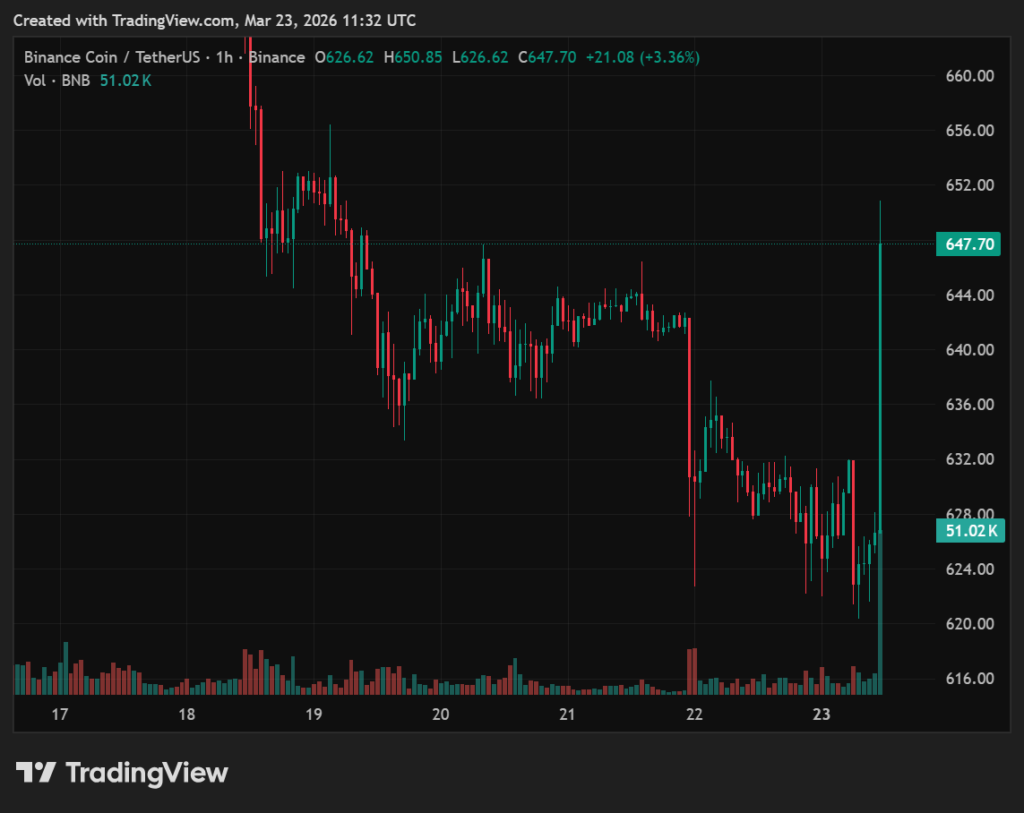
Current technicals & chart insight (use attached image here)
The attached TradingView chart shows BNB/USDT on the 1‑hour timeframe into March 23, 2026. Price spent several days chopping between roughly 620 and 645 dollars before a high‑volume green candle broke out toward the upper 640s, with hourly volume spiking above 50,000 BNB on Binance futures.
- A range‑break attempt after an extended consolidation between 616 and 645 dollars
- Buyers stepping in aggressively near the 620 support zone, as seen in repeated wicks and the final breakout bar
- Short‑term traders likely watching the 650–676 dollar resistance band highlighted by recent analyst targets.
Market fundamentals and token utility
BNB’s fundamentals still begin with its role as the native asset of the BNB Chain ecosystem, covering BNB Smart Chain, opBNB L2s, and BNB Greenfield storage. Holders use BNB for gas, staking, validator bonding, and governance proposals, giving the token direct exposure to on‑chain activity rather than just speculative demand.
A key structural driver in any Binance Coin crypto prediction is the Auto‑Burn mechanism, which dynamically reduces total supply toward 100 million BNB based on price and block production. On‑chain reports show that more than 1.3 million BNB were burned in January 2026 alone, meaning that rising network usage tightens circulating supply over time, similar in spirit to Ethereum’s fee burn but with a more programmatic schedule.
Quick tokenomics comparison
| Feature | BNB | Ethereum (ETH) | Solana (SOL) | Avalanche (AVAX) |
|---|
BNB’s mix of deflationary design and high‑utility demand makes it more comparable to ETH than to legacy exchange tokens, but its dependence on Binance’s centralized businesses remains a structural risk.
Ecosystem roadmap, on‑chain data, and BNB news
BNB Chain’s official 2026 roadmap targets over 20,000 TPS with deeper sub‑second finality, plus fee compression and a dual‑client stack using Geth and a new Rust‑based Reth implementation. The plan also includes a scalable database architecture with multi‑layered sharding to handle state growth without sacrificing performance, aimed squarely at high‑frequency trading and GameFi use cases.
Recent BNB news underscores this transition from “exchange token” to “Web3 infrastructure asset”:
- The network recorded a full year of zero downtime in 2025, matching or exceeding uptime standards of rival L1s.
- New opBNB rollups and Greenfield storage integrations are driving higher daily active addresses and DeFi total value locked (TVL), though still trailing Ethereum’s L2 stack.
- Whale accumulation on‑chain has ticked up since late Q4 2025, with large wallets consolidating holdings during pullbacks, a pattern historically associated with medium‑term uptrends in BNB.
From a behavioral finance angle, investors seem willing to accumulate on dips despite regulatory noise, reflecting a belief that BNB’s ecosystem cash‑flows (trading fees, gas revenue, staking yields) have tangible value.
ETF filings and regulatory overhang
Regulation is the biggest wild card in any Binance Coin crypto prediction. Grayscale filed a Form S‑1 for a spot BNB ETF on January 23, 2026, following an earlier proposal by VanEck in 2025. Both products would list on major U.S. exchanges and custody assets via Coinbase, but they still require corresponding 19b‑4 approvals from the SEC, and none has been approved as of March 2026.
Historically, the SEC has hinted that BNB could be treated as a security, which raises enforcement and disclosure questions for U.S. investors. A spot BNB ETF approval would likely mirror Bitcoin’s 2024 ETF moment: easier institutional access, more transparent price discovery, and potentially tighter spreads; in contrast, a rejection could cement BNB’s status as “off‑limits” for many regulated funds and amplify downside during risk‑off phases.
For traders, this means the ETF timeline is a binary catalyst:
- Positive path: Approval brings new spot demand and forces shorts to re‑price risk.
- Negative path: Delays or denials weigh on sentiment and might revive fears about exchange‑related enforcement.
Technical indicators and volatility lens
Technically, BNB remains below its October 2025 all‑time high near 1,370 dollars, trading at roughly a 54% discount to peak levels. Yet from its 2017 launch low around 0.096 dollars, long‑term holders still sit on outsized gains, showing how early exchange‑token buyers were compensated for taking platform risk.
Short‑term analyst models now flag:
- Resistance around 676 dollars, a level cited as the bullish breakout pivot for late March 2026.
- Support near 648 dollars on spot and derivatives order books, where previous demand has stepped in.
- An April 2026 forecast band between roughly 725 and 1,050 dollars, with an average projection near 890 dollars, implying potential 60–70% upside if risk conditions remain favorable.
In volatility terms, BNB’s price swings are generally lower than smaller‑cap DeFi tokens but higher than Bitcoin, placing it in a “moderate–high beta” bucket. Third‑party models projecting BNB to around 795 dollars within five years point to a mid‑single‑digit annualized return if bought at current levels, which looks reasonable but not extreme given historical Sharpe ratios for large‑cap crypto.
Behavioral finance and sentiment around BNB news
Investor psychology around BNB is unusually sensitive to Binance‑specific headlines. When regulatory investigations, leadership changes, or enforcement actions hit the newswire, BNB often sells off more sharply than peers, even if underlying chain metrics stay stable. Conversely, positive BNB news such as record fee burns, new launchpool events, or improved transparency in audits tends to spark rapid short‑covering rallies as traders reassess tail‑risk.
Two recent sentiment anchors:
- The reclaiming of 4th place in market cap from XRP, fueled by confidence in CeFi and DeFi utility rather than payments speculation, is modestly bullish but fragile given the small absolute gap.
- The broader crypto fear index sitting in the high‑20s indicates a “fear” regime, where traders demand higher risk premia and often fade rallies, making it harder for BNB to sustain parabolic moves despite improving fundamentals.
Understanding these psychological feedback loops is essential: even strong on‑chain data can be overshadowed temporarily by narrative shocks.
Scenario‑based Binance Coin crypto prediction
Bull case: ecosystem expansion and ETF green light
In the bull scenario, BNB Chain successfully hits its 20,000 TPS target, maintains sub‑second finality, and attracts a fresh wave of dApps in trading, GameFi, and consumer payments. Auto‑Burn continues to remove meaningful supply each quarter while dApp usage drives higher gas demand, pushing realized scarcity closer to Ethereum’s post‑EIP‑1559 dynamics.
If at least one U.S. spot BNB ETF gains approval, institutional inflows could rerate BNB toward higher valuation multiples closer to Ethereum’s, especially if Binance improves transparency and decentralization. Under this path, retesting the prior 1,370‑dollar high and exploring the 1,500–1,800 band over the next cycle would not be unreasonable, assuming the broader crypto market resumes a strong bull trend.
Base case: steady growth with manageable risk
In the base case, road‑map milestones roll out but not perfectly; throughput improves, fees fall, and dApp numbers grow, yet competition from Ethereum L2s and Solana caps how much value accrues to BNB. Regulatory progress is mixed ETF decisions drag on, but no major enforcement shock materializes, allowing BNB to track the general altcoin beta with slightly better performance thanks to its deflationary model.
Here, projections like Binance’s own five‑year forecast around 795 dollars and April 2026 targets in the 725–1,050 range serve as reasonable guideposts. Expected returns are solid but not explosive, favoring dollar‑cost‑averaging and yield‑focused strategies (staking, CeFi products) over pure leverage.
Bear case: regulatory pressure and competitive erosion
The bear case centers on regulation and relative under‑performance. If U.S. regulators label BNB a security and either reject ETF filings or pursue harsh actions against Binance, many centralized venues and funds may reduce exposure or delist. At the same time, if Ethereum L2s, Solana, or Avalanche capture the bulk of new users and liquidity, BNB Chain’s share of DeFi and NFT volumes could stagnate despite strong tech.
Under that combination, demand for BNB gas and staking weakens while risk premia rise, sending its risk‑adjusted Sharpe ratio below peers and pushing capital into other majors. Prices could revisit the 400–500 dollar band or lower during global risk‑off periods, particularly if Bitcoin also enters a deep drawdown.
Risk‑adjusted view for active crypto users
From a portfolio perspective, BNB sits between high‑beta altcoins and blue‑chip assets. Its long history, large market cap, and exchange backing give it more resilience than newer chains, but its regulatory concentration risk is also higher than most L1s not tied to a single CeFi brand.
Traders who size positions based on volatility could:
- Treat BNB as a satellite allocation around a BTC/ETH core, scaling entries near support levels like 620–650 dollars and trimming into the 700–900 band if April’s seasonal strength plays out.
- Monitor on‑chain whale accumulation, BNB burn announcements, and BNB Chain dApp metrics as leading indicators of sustainable rallies rather than trading only on ETF headlines.
Conclusion: how to use this Binance Coin crypto prediction
For crypto‑native users, this Binance Coin crypto prediction is a framework rather than a fixed target. BNB’s upside is tightly linked to the success of BNB Chain’s 2026 scalability roadmap, the outcome of U.S. spot ETF filings, and its ability to defend market share against Ethereum, Solana, and Avalanche.
If you believe in a future where centralized and decentralized infrastructures merge exchanges, rollups, and app‑chains all anchored by a single settlement token BNB remains a compelling, though higher‑risk, bet. If, however, you expect multi‑chain fragmentation and tougher U.S. enforcement, you may prefer to limit exposure, use BNB primarily for ecosystem utility, and lean more heavily on diversified L1 holdings.

Henry Cross is a crypto and blockchain writer who focuses on market analysis, price trends, and emerging digital assets. He simplifies complex topics into clear, practical insights that help readers understand the fast moving world of crypto with confidence.